Sep 13, 2026
Wet vs Dry Friction Plates: How to Choose the Right Type for Your Application
A practical comparison of wet and dry friction plates for clutch and brake applications: how each transfers torque, where each performs best, and the operating conditions that decide which type belong
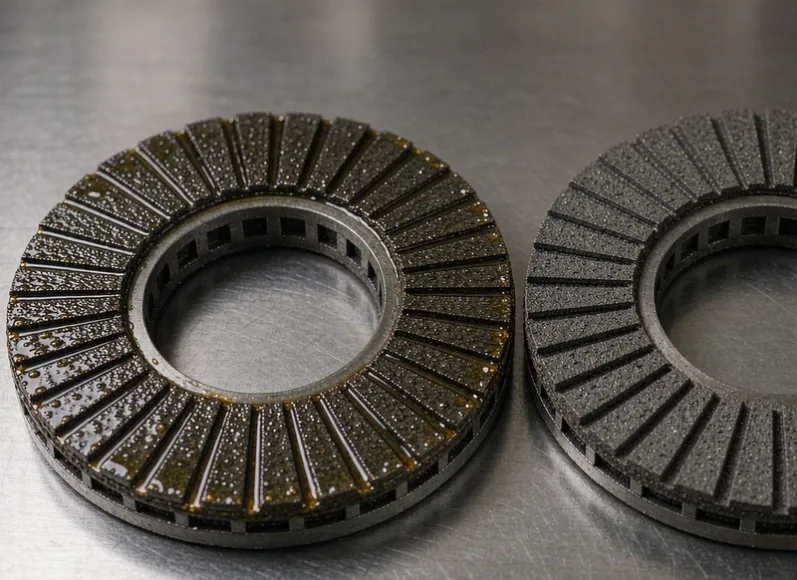
Wet and dry friction plates are not interchangeable. Both sit inside a clutch or brake pack and both convert rotational energy into clamp force, but the environment around them is completely different: one runs bathed in oil, the other runs open to the air. Choosing the wrong type means the plate either overheats in a dry location or slips in a wet one. For buyers specifying replacements for agricultural tractors, forklifts, construction equipment, and industrial transmissions, the wet-versus-dry decision comes before the material choice, because it determines how the plate is cooled, how it wears, and how the pack is built. This guide explains how each type works, where each performs best, and the operating signs that tell you which one your machine needs.
How a Wet Friction Plate Works
A wet friction plate operates fully submerged in or sprayed by oil. The oil carries heat away from the friction interface, lubricates the contact, and flushes wear debris through the grooves cut into the lining. Because the oil manages temperature, a wet plate absorbs high torque and repeated engagement cycles without glazing, which is why virtually every powershift transmission, forklift wet brake, and hydraulic clutch uses them. The trade-off is a lower friction coefficient, so wet packs need more clamp force and more plates to transmit the same torque as a dry pack. The steel separator plates between the friction discs also run wet, so the whole pack is designed as a matched, oil-cooled assembly.
How a Dry Friction Plate Works
A dry friction plate engages in air with no oil film between the surfaces. Without oil damping the interface, dry plates develop a higher friction coefficient and transmit more torque in a smaller, lighter pack, which is why they appear in manual transmissions, some brake systems, and applications where simplicity and cost matter more than continuous-duty cooling. The downside is heat: every engagement dumps energy into the lining as friction, and with no oil to carry it away the surface temperature spikes. Dry plates tolerate occasional engagement well but overheat under continuous slip or high-cycle duty, leading to glazing and rapid wear. For a closer look at how overheating damages a lining, see our failure modes guide.
Torque Density and Pack Size
When space and weight are tight, dry plates win on torque per unit volume because of the higher friction coefficient. When duty cycle is heavy and cooling is the priority, wet plates win because the oil removes heat continuously. A forklift that engages its wet brake dozens of times per shift runs cooler and lasts longer with a wet pack, while a manually shifted agricultural implement that engages rarely may be served perfectly by a dry plate at lower cost. The choice is rarely about which is better and almost always about engagement frequency and the heat that frequency generates.
Operating Environment: Oil, Dust, and Contamination
Wet plates need a clean, correctly specified oil supply; contaminated or low oil is the fastest route to glazing and scorching, and it takes the steel separators down with it. Dry plates are vulnerable to the opposite problem: dust, grit, and moisture in the engagement zone embed in the lining and accelerate wear or cause grab. In sealed, oil-lubricated transmissions, wet is the default. In open, dusty, or washdown environments where oil would attract abrasive contaminants, dry can be the more robust choice despite the heat limit. Matching the plate to the environment prevents the early failures that send buyers back to the cross-reference table.
Wear Behavior and Service Life
Wet friction plates wear slowly and predictably because the oil flushes debris and cushions engagement, and their grooves maintain oil film and cooling until they are worn through. Dry plates wear faster under load and show their condition more abruptly: a glazed, glassy surface or a cracked lining appears with little warning once the temperature limit is crossed. Neither type is maintenance free, but wet packs give more visible, gradual wear signals, while dry packs demand closer attention to engagement temperature. Regular inspection of the worn plate, as covered in our measurement guide, tells you which limit you are approaching before failure.
Material Choices Within Each Type
The wet-versus-dry decision does not replace the material decision; it shapes it. Wet plates are most often copper-based, iron-based, or paper-based, with a copper-based tractor clutch friction plate serving high-heat agricultural duty, iron-based resisting abrasion in forklift service, and paper-based cushioning engagement in industrial transmissions. Dry plates lean toward organic and ceramic formulations built to survive air-cooled heat spikes rather than oil immersion. Our material comparison guide breaks down how the three wet-plate families behave under load, heat, and oil, and the right material still has to match both the wet or dry environment and the duty cycle.
Reading the Existing Pack to Identify the Type
When replacing a plate, the installed pack tells you the type unambiguously. Wet plates sit in an oil-filled housing with visible grooves and steel separators, and the friction lining is usually thinner and bonded or riveted to a steel core. Dry plates sit in an open or lightly enclosed space, often with a thicker, more aggressive lining and fewer discs. The part number, the machine's lubrication diagram, and the presence or absence of an oil feed at the clutch location confirm the type. If the original number is illegible, our OE identification guide explains how to read the stamped reference, and the sourcing guide shows how to cross-reference it to the correct replacement.
When the Original Type Is Discontinued or Wrong
Sometimes the goal is not to repeat the original but to correct it. If a dry pack is overheating in continuous-duty service, converting to a wet pack with the appropriate separator and oil supply restores life. If a wet pack is glazing from contaminated oil that cannot be economically fixed, a dry conversion may simplify the build. These changes are engineering decisions, not drop-in swaps, and usually require custom plates and matched separators. Our custom sourcing guide covers minimum order quantities, lead times, and the drawings or samples a manufacturer needs to produce a corrected plate to specification.
Conclusion
Wet and dry friction plates solve the same problem in opposite environments: wet plates trade a lower friction coefficient for continuous oil cooling and long, predictable life in high-cycle duty, while dry plates trade cooling for a higher coefficient and a smaller, lighter pack that suits low-frequency engagement. Choose wet where the clutch or brake runs oil-cooled and engages often, and dry where weight, cost, and simplicity matter and engagement is infrequent. Whichever type your machine uses, match the material family to the duty cycle, inspect the worn plate before ordering, and confirm the type from the pack and the lubrication diagram rather than memory. For help identifying the right plate from a part number or sample, our FAQ covers replacement intervals and material selection, and as a friction plate manufacturer we support buyers with dimensional verification, material matching, and custom production for agricultural, forklift, and construction applications.